What is the Farthest Galaxy?
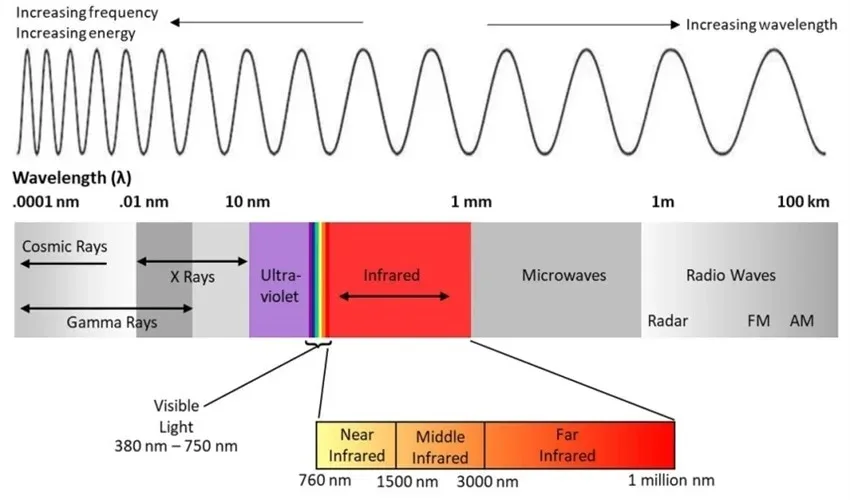
When we look out in the Universe, we are looking back in time. This is because light given off by distant galaxies takes time to reach us. To discover the furthest galaxies, we need to look into the distant past. Light is stretched as it travels through the Universe. This means if we want to see more distant galaxies we need to use very powerful telescopes that observe at longer wavelengths, called infrared wavelengths. Infrared is ~700nm (10-6mm) to 1mm wavelength.
The James Webb Space Telescope (JWST) is the answer. It is the largest (6.5m diameter mirror), most powerful infrared space observatory. It launched on 25th December 2021. Then in January 2024 JWST discovered a record-breaking galaxy, known as MoM-z14 (shown in the pullout in the image below). It is seen only 280 million years after the Big Bang. The Big Bang occurred 13.8 billion years ago. This means that this galaxy is 13.52 billion years old! MoM-z14 was at a distance of 13.52 billion light years from us when it emitted the light we see today! But the galaxy didn’t just stop moving when it emitted the light we see – it kept moving away! Scientists estimate that MoM-z14 is now 33.8 billion light years away from the Earth.
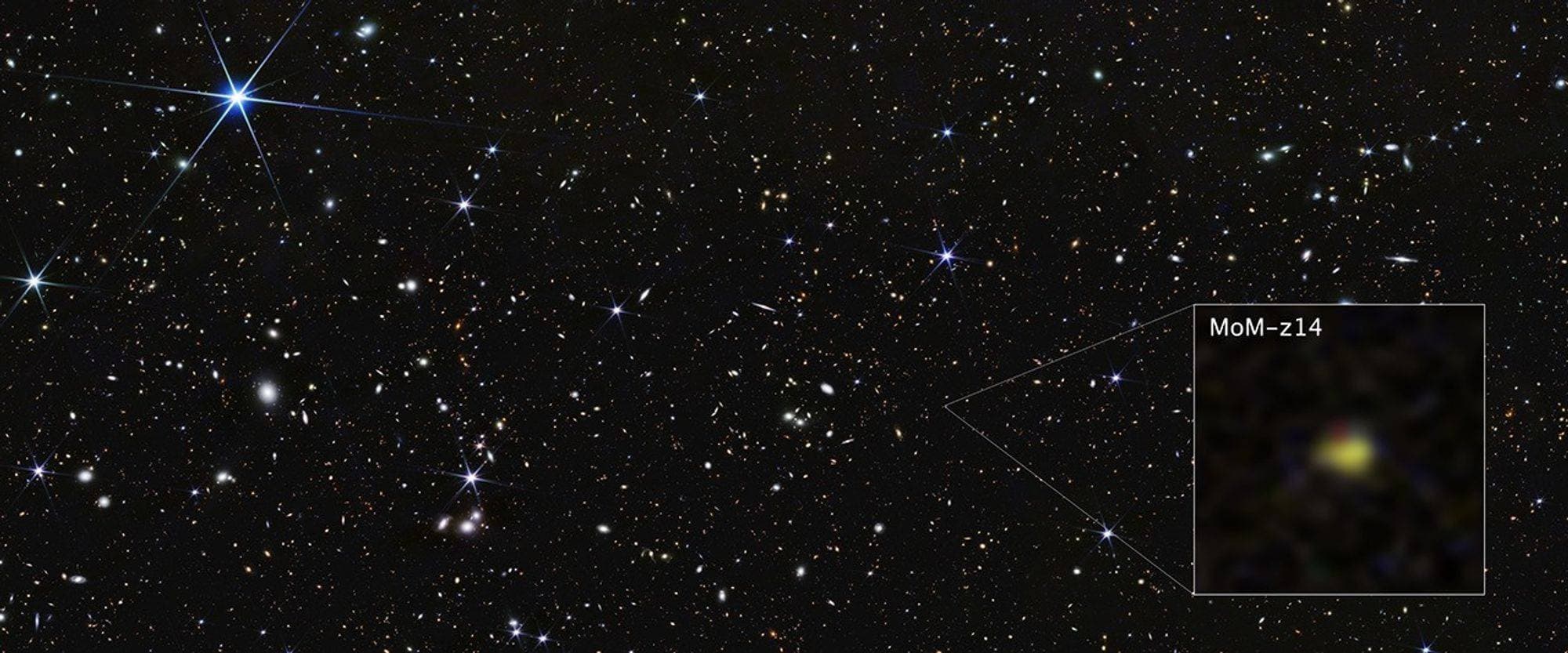
Credits: Image: NASA, ESA, CSA, STScI, Rohan Naidu (MIT); Image Processing: Joseph DePasquale (STScI)
MoM-z14 is the most distant of a group of surprisingly bright galaxies which JWST has discovered in the early universe. There are approximately 100 times more galaxies in this early time than scientists predicted. MoM-z14 also surprised astronomers as it has lots more nitrogen than expected. The Universe started with only hydrogen and scientists thought it would take longer to create the amount of nitrogen seen here.
Conclusion
- The furthest galaxy discovered was 13.52 billion light years away when it emitted the light we see today.
- Because it kept moving after it emitted the light we see, scientists estimate it is now 33.8 billion light years away from us.
- It formed only 280 million years after the Big Bang.
- It is called MoM-z14.
- It was discovered by the James Webb Telescope in Infrared Light.
Fun facts
- When we look at distant galaxies we are looking back in time.
- The early galaxies are tiny only ~1-2% the size of our Milky Way Galaxy.
Written by Dr Heather Campbell for Just Good Science Ltd.
https://www.azooptics.com/Article.aspx?ArticleID=1666
Leave a Reply
You must be logged in to post a comment.

