What is artificial intelligence and how does it work?
How can a computer recognise a face, recommend a film, or write a paragraph? It doesn’t have a brain. It doesn’t have thoughts. So what is really happening?
Artificial intelligence, or AI, describes computer systems designed to carry out tasks that we usually connect with human thinking. These tasks include recognising patterns, understanding language, sorting information and making predictions.
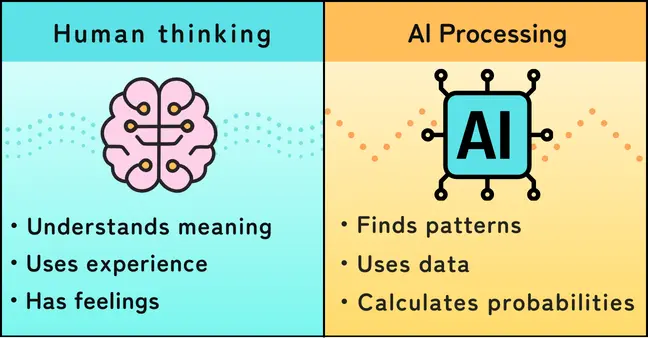
But computers do not think like humans. They follow instructions and use mathematics to process information. The reason AI seems intelligent is because it is very good at spotting patterns.
AI works by learning from data
Data simply means information. It can be pictures, words, sounds or numbers. An AI system is shown a very large number of examples. It studies those examples and looks for patterns that repeat.
Imagine showing a computer thousands of pictures of cats and dogs. Over time, it begins to notice differences. Cats might have certain ear shapes. Dogs might have longer noses. The computer does not understand what a pet is. It learns which patterns are usually linked to the label “cat” or “dog”.
This process is called machine learning. The more examples the system studies, the better it becomes at predicting the correct answer.
You can think of it like a student revising for an exam. If they practise hundreds of maths questions, they begin to recognise which method to use just by spotting patterns in the question. AI improves in a similar way. It becomes accurate because it has analysed many examples.
Does AI think like a human?
No. AI does not have thoughts, feelings or opinions. It does not understand meaning in the way people do. It looks at patterns in data and calculates the most likely response. If the information it learns from is unclear or incorrect, then AI can make mistakes. That is why the quality of training data matters.
What is generative AI?
Some AI systems do more than sort or recognise information. They create new content. This is known as generative AI.
Generative AI can produce text, images, music or video. It does this by studying enormous collections of existing material and predicting what should come next.
For example, if you type “The sky is…”, the system predicts the word most likely to come up next, based on patterns it has seen in millions of sentences. It does not look outside to check. It predicts using patterns.
Where is AI actually used?
AI is already used in many everyday technologies.
When a streaming service suggests something to watch, it is analysing patterns in viewing habits.
When your phone unlocks using your face, it matches patterns in your features.
When your keyboard corrects spelling, it relies on common word patterns.
When a navigation app suggests a quicker route, it analyses traffic data and predicts delays.
In every case, the system is recognising patterns and making predictions and is not thinking independently.
AI is likely to continue influencing how people learn and work. In schools, it can help explain topics in different ways or provide practice questions. However, it does not replace understanding. Human judgement and critical thinking are still essential.
Summary
• Artificial intelligence (AI) allows computers to perform tasks linked to human thinking.
• AI works by analysing large amounts of data and spotting patterns.
• Machine learning helps AI improve as it studies more examples.
• Generative AI creates new content by predicting what comes next.
• AI is already used in everyday technology.
Fun Facts
• The term “artificial intelligence” was first used in 1956.
• Some AI systems are trained using billions of pieces of text.
• AI can help scientists analyse patterns that lead to new medical discoveries.
Written by Laura Ash for Just Good Science Ltd.
Leave a Reply
You must be logged in to post a comment.

