How big is our Milky Way Galaxy?
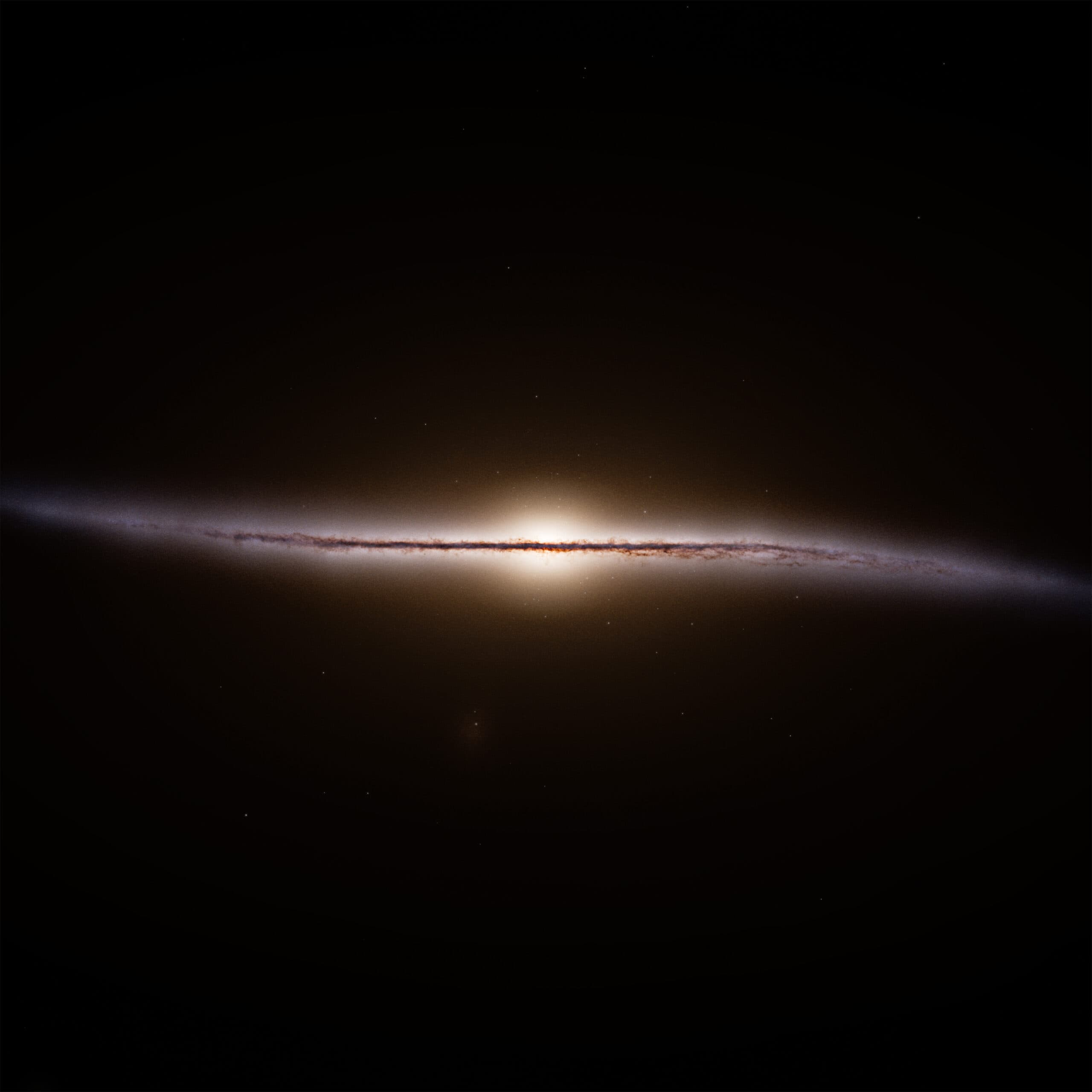
Our Milky Way Galaxy is a flat spiral shape. It is about 100,000 light-years across, but its vertical height is only 1000 light-years. It’s flat, a bit like a pizza or a fried egg!
The Sun does not live near the centre of our Galaxy. It lies about 26 000 light-years from the Galactic Centre – roughly half way between the centre and the outskirts on one of the four spiral arms. The arm that its its in is called the Orion Arm.
The Milky Way weighs about 200 hundred billion solar masses (1 solar mass is the mass of our Sun). The Galaxy has about 200 billion stars and at the centre is a 4-million-solar-mass supermassive black hole.
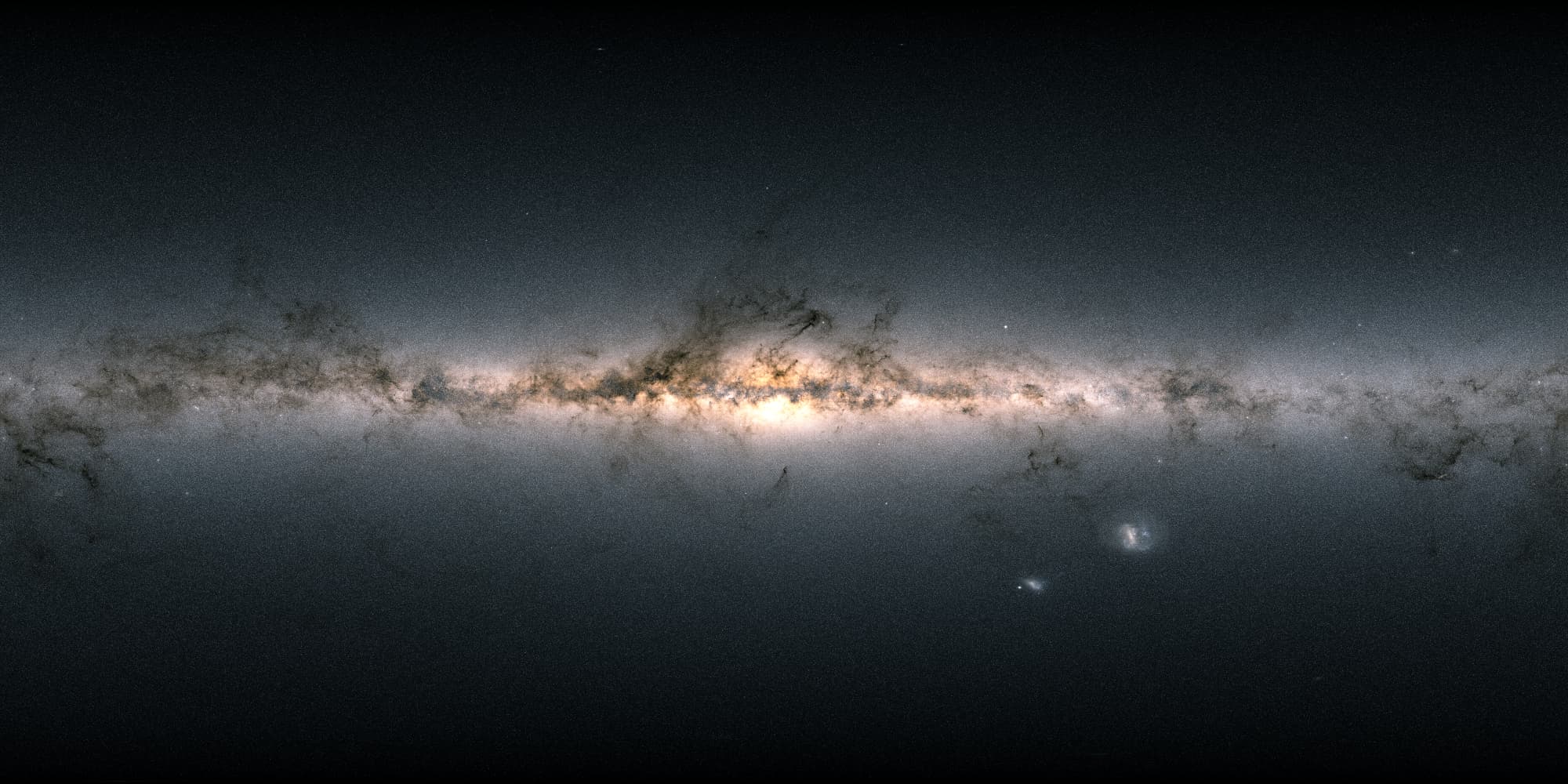
ESA/Gaia/DPAC, Stefan Payne-Wardenaar LICENCE CC BY-SA 3.0 IGO or ESA Standard Licence
But how do we know the size?
It’s really hard to tell the size of our Milky Way galaxy as we are inside it. The same as here on Earth, it is hard to tell how big a town is when you are living in it. You need an airplane or satellite to fly high above the town to take an image looking back to show the size. However, with our Galaxy, we can’t travel outside to take an image looking back. Instead the Gaia satellite used parallax measurements to accurately measure distances to 1.8 billion stars. Parallax is a way of measuring distances using triangles, as shown in the diagram. You can try out the concept of parallax yourself. Hold a finger out in front of your face and close one eye. Look at the position of your finger in relation to objects in the background. Now change eyes and your finger appears to move against the more distant objects. This is parallax!

We can not put the whole Galaxy on a weighing scale, so we have to use other methods to estimate the mass of our Galaxy. Scientists also used the Gaia space telescope data to measure the speed of stars. This allowed astronomers to measure how fast our Galaxy rotates.
Conclusions
- The Milky Way Galaxy is 100,000 light-years across.
- The Sun lies about 26 000 light-years from the Galactic Centre.
- The Milky Way weighs about 200 hundred billion solar masses.
- The Galaxy has about 200 billion stars.
Fun Facts
- Astronomers use parallax to measure distances to stars and this is the same reason we have two eyes to estimate how far away things are from us.
Written by Dr Heather Campbell for Just Good Science Ltd.
References
- https://imagine.gsfc.nasa.gov/features/cosmic/milkyway_info.html
- https://esahubble.org/news/heic1905/
- https://www.esa.int/ESA_Multimedia/Images/2020/12/Interactive_map_of_the_sky_from_Gaia_s_Early_Data_Release_3
- https://www.esa.int/Science_Exploration/Space_Science/Gaia/Gaia_creates_richest_star_map_of_our_Galaxy_and_beyond
- https://www.cosmos.esa.int/web/gaia/iow_20230927#
- https://www.esa.int/Science_Exploration/Space_Science/Gaia/Guide_to_our_galaxy
Leave a Reply
You must be logged in to post a comment.

