What’s inside a black hole?
Short answer: We don’t really know! And they’re not even really holes!
In fact, they are the opposite. They are huge concentrations of matter squashed into extremely small spaces. This makes black holes incredibly dense. The gravity just below the ‘surface’ of the black hole, called the event horizon, is so strong that nothing, not even light itself can escape. But what matter looks like within the black hole, we don’t know! The event horizon blocks our view of the strange physics inside the black hole.
At the centre is a region scientists call the singularity, which is zero volume but infinite gravity – or does it? This is what it would be like in normal or classical physics. However, under such huge forces our classical physics breaks down.
2 main types of black holes
- Stellar-mass black holes – three to dozens of times the Sun’s mass. We have observed these types of black holes throughout our Milky Way galaxy.
- Supermassive black holes – massive black holes weighing 100,000 to billions of times the mass of our Sun. Supermassive black holes lurk at the centres of most big galaxies, including our Milky Way galaxy.
What are some current theories of what’s inside a black hole?
- Some physicists believe the very fabric of space time is punctured at the singularity.
- The cosmologist Professor Stephen Hawking developed a theory, Hawking radiation, that particles would leak back into space from a black hole and thus black holes can very slowly evaporate away.
- Theoretical physicist Lee Smolin goes further as has suggested time ends within a black hole and begins a new Universe.
- Another theory, is that the black hole contains a ball of vibrating strings – fuzzball theory.
What are scientists doing to try to discover more?
We can’t usually observe black holes directly, since they don’t emit or reflect light, they are invisible to telescopes. Instead scientists detect and study them based on the effects they have on their surroundings.
- Black holes often have rings of gas and dust around them called accretion discs. These can be seen by modern telescopes.
- Supermassive black holes have gravity, just like luminous space objects. This affects the motion of stars near them. Astronomers can see stars in their telescopes and have detected the orbits of several stars near the centre of our Milky Way and used their data to prove there is a supermassive black hole, Sgr A* at the centre of the Galaxy. This won the 2020 Nobel Prize.
- As extremely massive objects, like black holes, accelerate through space, they cause ripples in the very fabric of space-time itself. These ripples are called gravitational waves. Astronomers detect these ripples with huge detectors on Earth.
- Massive objects, such as black holes, can bend and distort light from objects further off in the Universe. This effect is called gravitational lensing. Astronomers use this technique to discover ‘invisible’, isolated black holes.
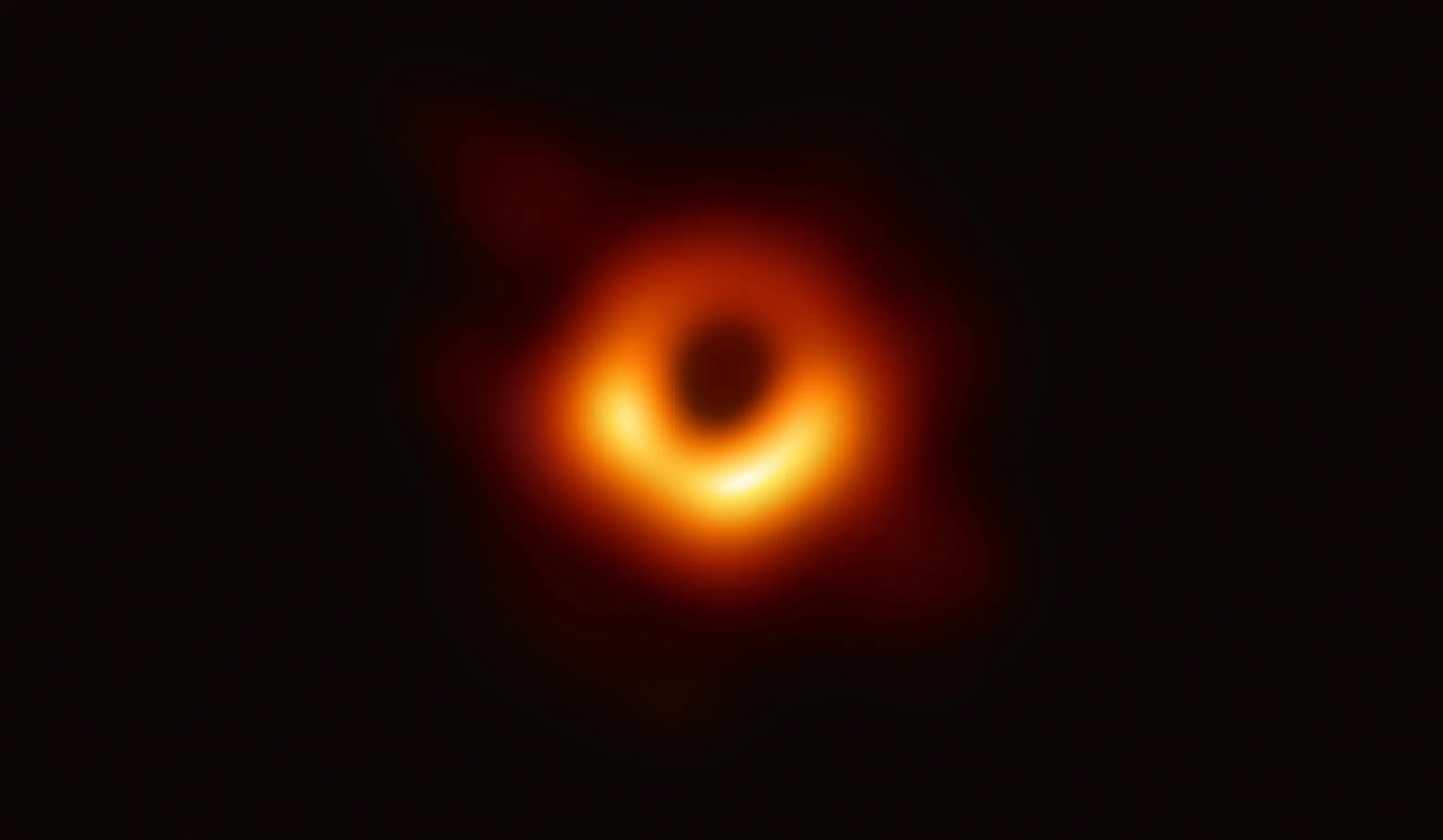
In 2019, astronomers using Event Horizon Telescope (EHT) captured an image of a black hole for the first time. It appears as a dark circle silhouetted by an orbiting disk of hot, glowing matter. The supermassive black hole is located at the heart of a huge galaxy called M87, located about 55 million light-years away, and weighs more than 6 billion times the mass of our Sun.
Conclusion
- Black holes are not really holes. Instead they are hugely dense matter squeezed into a tiny space.
- No light or matter can escape a black hole.
- We can never see inside the event horizon of a black hole.
- There are many theories of inside a black hole but at present, we believe our current physics breaks down at the centre of the black hole.
Fun facts
- Spaghettification – this great word describes what happens to matter that gets too close to a black hole. It is stretched vertically and squashed horizontally, so it ends up like spaghetti.
- Black holes are not wormholes. They are not shortcuts between different points in space, or portals to other universes.
- Black holes are not cosmic vacuum cleaners. Black holes don’t suck all the matter! From far enough away, their gravitational pull is the same as a normal object of the same mass.
Written by Dr Heather Campbell for Just Good Science Ltd.
References
Leave a Reply
You must be logged in to post a comment.

