
Why does lightning zigzag?
You may have watched a thunderstorm and noticed that lightning never seems to travel in a neat straight line. Instead, it flashes across the sky in sharp angles, with branches that spread out like cracks in glass. It can look wild or random, but the shape of lightning is actually telling us something important about how electricity moves through the air.
What is lightning?
Lightning is a huge spark of electricity. Inside a storm cloud, small ice particles and water droplets crash into each other as they are thrown around by strong winds. These collisions cause electric charge to build up, with different parts of the cloud becoming positively or negatively charged.
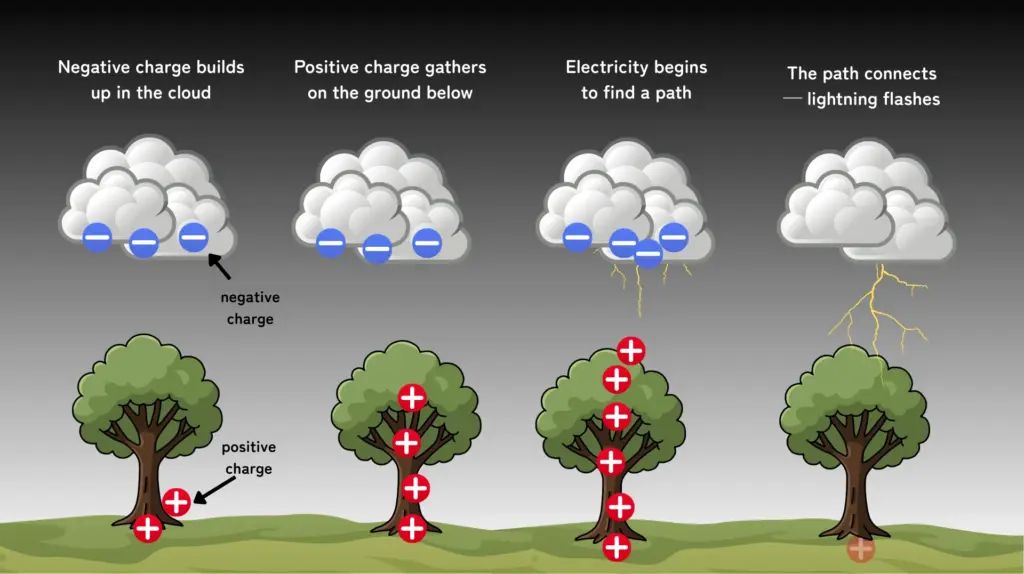
When the difference in charge becomes large enough, the electricity suddenly moves to balance things out. That rapid movement of charge is what we see as lightning.
Why doesn’t it travel straight to the ground?
It might seem like the electricity should rush straight down, just like electricity flows through a wire.
But air is not like a wire. Air is normally an insulator, which means electricity cannot move through it easily. For lightning to happen, the charge has to force its way through the air, and that is much harder than travelling through metal.
Because of this, lightning cannot simply take a direct route.
Is the air the same everywhere?
No. Even though the air looks smooth and invisible, it actually contains tiny differences from place to place. Some regions are slightly warmer, some contain more moisture, and some have dust or droplets mixed in.
These small changes affect how easily electricity can pass through. Some parts of the air allow charge to move more easily than others.
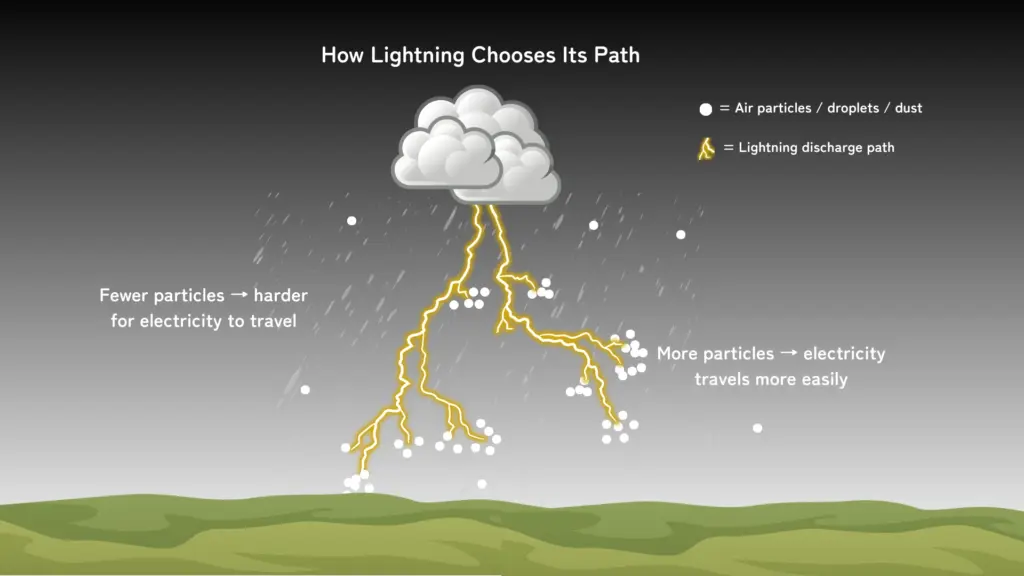
Lightning has to build a path through the air. Where there are more molecules, droplets, or dust, the path forms more easily, so it turns toward those regions.
How does lightning decide where to go?
Electricity always follows the path that is easiest, not the path that is shortest.
As the charge moves, it pushes forward into nearby air where it can travel a little more easily. Then it builds up again and pushes forward once more. Each movement is only a short jump, and each jump may head in a slightly different direction.
This happens extremely quickly, but it means lightning is forming its path as it goes.
Why does it zigzag instead of making one smooth line?
Because each step depends on what the air is like just around it, the direction keeps changing. Lightning is constantly adjusting, turning towards the next easiest route.
The zigzag shape is the result of many tiny changes in direction added together.
Why do we sometimes see branches?
Sometimes the electricity spreads into more than one direction at the same time, testing several routes through the air. These appear as forks or branches.
Most of these branches stop growing, but one eventually connects with the ground or another charged region. When that connection is made, a large flow of electricity happens and we see the bright flash.
Does lightning take the shortest path?
No. This is a very common misunderstanding.
Lightning does not travel in a straight line to get to the ground as quickly as possible. It follows the path where electricity can move most easily at each moment.
Does lightning know where it is going?
It may look planned, but it isn’t.
Lightning does not decide its route in advance. It explores different directions step by step until one pathway finally works.
Where does lightning happen most often?
Lightning occurs most frequently in warm, humid regions where strong storm clouds form easily. Some places experience it far more than others. Around Lake Maracaibo in Venezuela, storms can produce lightning on hundreds of nights each year.
Very cold and dry places, such as Antarctica, rarely experience lightning because the conditions needed to build up large amounts of charge do not often occur.
So what does the zigzag tell us?
The jagged shape of lightning is a clue that electricity is forcing its way through an uneven atmosphere, building a path step by step.
Rather than being random, every lightning bolt is the result of electricity finding its way through the air as efficiently as it can.
Fun Facts
• At any moment, dozens of lightning flashes are happening somewhere on Earth.
• Most lightning never reaches the ground — it travels between clouds instead.
• A single lightning bolt can heat the air to temperatures hotter than the surface of the Sun for a brief moment.
• The thunder you hear is caused by the air expanding rapidly after being heated by the lightning.
Written by Laura Ash for Just Good Science Ltd.
Leave a Reply
You must be logged in to post a comment.

